

Drones have revolutionized the way we capture moments, explore landscapes, and even conduct professional tasks. Yet, many believe that acquiring a capable drone requires a significant financial investment. This is a common misconception!
In 2026, the market is brimming with incredible options that prove you don’t need to break the bank to experience the thrill of flight and stunning aerial photography. If you’re searching for the best drone under $300, you’re in luck.
This comprehensive guide will navigate you through the top contenders, key features to prioritize, and essential tips to ensure your first (or next) drone purchase is a soaring success. Prepare to discover how accessible high-quality drone technology has become!
Key Takeaways
- Affordable Quality Exists: In 2026, you can find drones under $300 with impressive cameras (up to 2.7K), stable flight, and intelligent features.
- Prioritize Your Needs: Focus on camera quality, battery life, stability, and ease of use based on whether you’re a beginner, photographer, or just seeking fun.
- Essential Features: Look for GPS, optical flow positioning, one-key return, headless mode, and a decent controller for a good flying experience.
- Read Reviews and Compare: Don’t just pick the cheapest; research user experiences and compare specifications to find the best value.
- Learn Before You Fly: Understand local drone regulations and practice in open spaces to ensure safe and enjoyable flights.
What to Look for in the Best Drone Under $300 in 2026
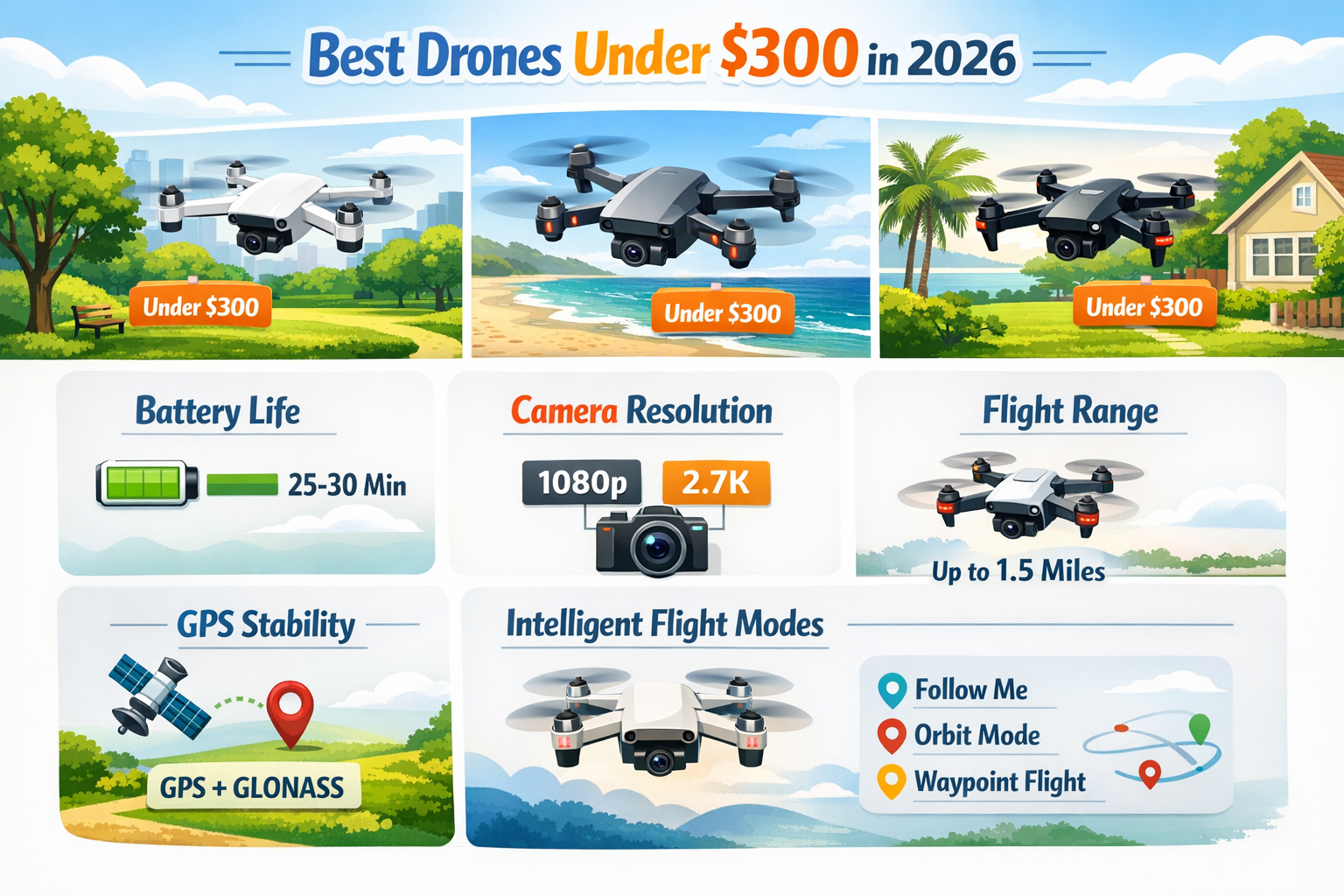
The sub-$300 drone market has matured significantly, offering features once exclusive to much pricier models. However, it’s crucial to understand what compromises might exist and how to identify the most critical specifications for your needs. When evaluating the best drone under $300, consider the following aspects:
Camera Quality and Gimbal
For many, the primary appeal of a drone is its ability to capture breathtaking aerial photos and videos. While a professional 4K camera with a 3-axis gimbal might be out of reach in this price bracket, you can still find excellent options.
- Resolution: Look for drones offering at least 1080p (Full HD) video recording. Some advanced models even boast 2.7K resolution, which provides significantly more detail and flexibility for editing. Megapixels for still photos are also important; aim for at least 8MP if photography is a priority.
- Image Stabilization: This is perhaps the most critical factor for smooth footage. While a true mechanical 3-axis gimbal is rare under $300, many drones offer electronic image stabilization (EIS) or a 1-axis gimbal for tilt control. EIS digitally smooths out shaky footage, making a huge difference in video quality. Without any stabilization, your videos will likely appear jittery and unwatchable.
- Field of View (FOV): A wider FOV (e.g., 110-120 degrees) allows you to capture more of the scene, which is great for landscapes.
- Adjustable Camera Angle: Being able to tilt the camera remotely from your controller adds immense versatility to your shots.
Flight Performance and Stability
A good camera is useless if the drone is difficult to control or prone to drifting. Stability is paramount, especially for beginners.
- GPS Positioning: This is a game-changer. GPS allows the drone to hold its position accurately in the air, even in windy conditions, making it much easier to fly and capture steady footage. It also enables intelligent flight modes like “Return to Home.”
- Optical Flow Positioning: For indoor flights or areas without GPS signal, optical flow sensors help the drone maintain its altitude and position by analyzing the ground pattern below. This is especially useful for hovering steadily indoors.
- Flight Time: Battery life is a common limitation for budget drones. Aim for a drone that offers at least 15-20 minutes of flight time per battery. Many budget drones come with multiple batteries, which significantly extends your flying sessions. Always check if extra batteries are included or easily purchasable.
- Range: This refers to how far the drone can fly from the controller before losing signal. For sub-$300 drones, a range of 300-500 meters (around 1,000-1,600 feet) is generally good. Beyond that, you risk losing connection and potentially your drone.
- Wind Resistance: While smaller, lighter drones will always struggle in strong winds, some are built with better motors and more stable flight algorithms to handle light breezes more effectively.
Ease of Use and Intelligent Features
Especially for newcomers, features that simplify the flying experience are invaluable.
- One-Key Takeoff/Landing: This automates the most common tricky parts of flying, letting you launch and land with a single button press.
- Headless Mode: This feature simplifies controls by making the drone’s “front” always be the direction you’re facing, regardless of its actual orientation. Great for beginners who might get disoriented.
- Altitude Hold: Keeps the drone at a set altitude automatically, allowing you to focus on camera control.
- Follow Me Mode: If equipped with GPS, some drones can automatically follow you, keeping you in the shot. This is a fantastic feature for capturing action shots of yourself.
- Waypoints: Program a flight path for the drone to follow autonomously.
- Circle Fly/Point of Interest: The drone orbits a designated point, keeping it in the center of the frame – perfect for cinematic shots.
- Controller Quality: A comfortable, responsive controller with clear button labels makes a big difference. Some controllers have built-in screens, while others use your smartphone.
Durability and Portability
Drones, especially for beginners, are prone to occasional bumps and crashes.
- Material Quality: Look for robust ABS plastic construction. Propeller guards are a must-have for beginners, protecting both the propellers and anything the drone might hit.
- Foldable Design: Many modern drones, even budget ones, feature foldable arms, making them incredibly compact and easy to transport in a backpack.
- Brushless Motors: While sometimes found in the higher end of the sub-$300 category, brushless motors are more efficient, durable, and quieter than brushed motors, offering a better flight experience.
FPV (First Person View) and App Experience
- FPV Transmission: Most budget drones transmit video to your smartphone in real-time, allowing you to see what the drone sees. Check for low latency (minimal delay) for a smoother FPV experience.
- Companion App: A well-designed, intuitive app is crucial for accessing advanced features, viewing real-time footage, and calibrating the drone. Read reviews about the app’s stability and functionality.
Pull Quote: “In 2026, the ‘best drone under $300’ isn’t just a toy; it’s a gateway to aerial photography and FPV flying, packed with features that were once only dreams in this price range.”
Top Contenders for the Best Drone Under $300 in 2026
Based on current market trends, user reviews, and feature sets, several drones consistently stand out as excellent choices within the sub-$300 price bracket in 2026. These models offer a fantastic balance of performance, features, and affordability, catering to various needs from casual flying to budding aerial photography.
1. Holy Stone HS720E (Often on Sale Under $300)
[[IMAGE PROMPT FOR THIS SECTION]]
The Holy Stone HS720E is a perennial favorite and a strong contender for the best drone under $300 when found on sale, which it often is. It consistently punches above its weight, offering features typically found in higher-priced models.
- Camera: The HS720E boasts a 4K UHD camera (on some models, check specifications) capable of recording at 30fps, often paired with Electronic Image Stabilization (EIS). This combination significantly reduces shakiness, resulting in remarkably smooth and clear video footage for its price point. It also offers a 90° adjustable camera angle, allowing for diverse shot compositions.
- Flight Performance: This drone truly shines with its GPS-assisted intelligent flight modes. It features accurate GPS positioning, enabling stable hovering, “Return to Home” functionality (low battery, signal loss, or one-key trigger), and intelligent flight modes like Follow Me, Circle Fly, and TapFly (Waypoints). The powerful brushless motors contribute to stable flight and better wind resistance than many competitors.
- Battery Life: With a single battery, you can expect around 23-26 minutes of flight time, which is excellent for this category. Many packages include a second battery, extending your aerial adventures.
- Ease of Use: One-key takeoff/landing, headless mode, and a user-friendly app make it accessible for beginners, while the advanced features provide room for growth.
- Portability: Its foldable design makes it compact and easy to carry, ideal for travel and outdoor adventures.
Pros:
- Excellent EIS for smooth 4K/2.7K video (depending on model)
- Reliable GPS positioning and intelligent flight modes
- Long flight time per battery (23-26 minutes)
- Brushless motors for durability and performance
- Foldable and portable design
Cons:
- Can sometimes exceed $300, requiring a sale
- Still not a true mechanical gimbal (but EIS is very effective)
- App interface can be slightly less polished than premium brands
Ideal For: Aspiring aerial photographers and videographers who want excellent footage stability and advanced flight modes without a hefty price tag. It’s also a great step-up drone for experienced hobbyists.
2. Ryze Tello (Powered by DJI)
While it might not have the long flight times or high-resolution camera of others on this list, the Ryze Tello is a unique and incredibly valuable option for specific users, especially when considering the best drone under $300 for educational purposes or indoor flying. Its “Powered by DJI” moniker isn’t just marketing – it benefits from DJI’s renowned flight technology.
- Camera: It sports a 5MP camera capable of 720p HD video. While not cinematic, the footage is surprisingly stable thanks to its excellent electronic image stabilization. It’s perfect for casual social media sharing and learning basic photography principles.
- Flight Performance: The Tello excels in indoor stability due to its Vision Positioning System (optical flow). It’s incredibly easy to fly, responds well to commands, and can perform various “EZ Shots” like Circle, 360, and Up & Away for quick, cinematic-looking clips.
- Battery Life: You get about 13 minutes of flight time, which is decent for its size, but additional batteries are highly recommended.
- Ease of Use: The Tello is designed for simplicity. It can be controlled via a smartphone app (which is very intuitive) or with an optional Bluetooth game controller for a more traditional feel. It supports Scratch programming, making it an excellent tool for teaching coding to kids and beginners.
- Durability & Portability: Extremely lightweight and compact, it’s quite resilient to minor bumps. Propeller guards are included.
Pros:
- Exceptional stability, especially indoors (DJI flight tech)
- Great for learning to fly and basic aerial photography
- Supports Scratch programming for educational purposes
- Affordable and very portable
- “EZ Shots” for cinematic effects
Cons:
- Limited 720p video resolution
- Short flight time (13 minutes)
- No GPS, so less stable outdoors in wind
Ideal For: Beginners, children, educators, and anyone looking for a highly stable and easy-to-fly indoor drone with educational potential. It’s a fantastic entry point into the drone hobby.
3. Potensic ATOM SE (Newer Contender)
The Potensic ATOM SE has quickly made a name for itself as a formidable competitor, offering a package that feels significantly more premium than its price suggests, making it a strong contender for the best drone under $300 in 2026.
- Camera: It features a 2.7K camera that records at 30fps and often includes a strong EIS, delivering surprisingly good image and video quality for its price. The adjustable camera angle allows for more dynamic shots.
- Flight Performance: The ATOM SE boasts a robust GPS system for stable outdoor flight and precise positioning. It supports a remarkable transmission range of up to 4KM (approximately 2.5 miles) with the brand’s proprietary PixSync 2.0 technology, a feature usually reserved for much more expensive drones. This provides incredible freedom and reduces the worry of losing signal. Intelligent flight modes like Follow Me, Circle Fly, and Waypoints are also included.
- Battery Life: Impressively, it offers up to 31 minutes of flight time per battery, rivaling top-tier drones. This is a huge advantage for extended flying sessions.
- Ease of Use & Portability: It’s incredibly lightweight at under 249g (meaning no FAA registration required in the US for recreational use [1]), and its foldable design enhances portability. The controller is ergonomic, and the app is generally well-regarded for its user-friendliness.
Pros:
- Excellent 2.7K camera with EIS
- Remarkable 31-minute flight time per battery
- Long 4KM transmission range
- Under 249g (no FAA registration for recreational use)
- GPS and intelligent flight modes
- Portable, foldable design
Cons:
- EIS is digital, not a mechanical gimbal
- Newer brand, so long-term support might be less established than DJI
Ideal For: Users who prioritize long flight times, extended range, and solid camera performance in a highly portable package, especially those wanting to avoid FAA registration (in relevant regions).
4. DEERC D50 (Budget-Friendly Feature Set)
The DEERC D50 offers a compelling package for those seeking many popular features at the absolute lower end of the sub-$300 spectrum, often retailing significantly below the $200 mark. It’s a great option if you need a true entry-level best drone under $300 with some smart capabilities.
- Camera: Equipped with a 2K camera, it provides decent resolution for casual photos and videos. While it lacks advanced stabilization, the footage is acceptable for sharing on social media or personal viewing. The camera angle is often adjustable manually before flight or with a 1-axis tilt during flight on some variants.
- Flight Performance: It integrates GPS for stable outdoor hovering, automatic return home, and includes beginner-friendly features like altitude hold. The flight stability is reasonable for its price, making it manageable for new pilots.
- Battery Life: You can expect around 15-20 minutes of flight time per battery. Many DEERC packages come with multiple batteries (often two or three), significantly extending your fun.
- Ease of Use: Features like one-key takeoff/landing, headless mode, and speed adjustments make it very accessible for first-time flyers. The companion app offers intuitive controls and FPV viewing.
- Durability: Typically constructed from sturdy plastic with propeller guards included, it can withstand minor impacts, which is a common occurrence for beginners.
Pros:
- Very budget-friendly, often well under $200
- 2K camera provides decent resolution
- GPS for stable flight and Return to Home
- Multiple batteries often included
- Great for absolute beginners
Cons:
- No advanced image stabilization (EIS or gimbal)
- Shorter flight range compared to other GPS drones
- Less wind resistant due to lighter build
Ideal For: Complete beginners who want a functional drone with GPS and a decent camera without a significant investment. It’s a great stepping stone before committing to a more advanced model.
5. Contixo F24 Pro (Another Strong Value Option)
The Contixo F24 Pro is another drone that frequently enters the discussion for the best drone under $300 due to its robust feature set and competitive pricing. It often provides a good balance for those looking for a capable flyer with a decent camera.
- Camera: It usually comes with a 4K camera (often interpolated, meaning software enhances a lower resolution sensor) that delivers 1080p real-time transmission. While not true native 4K, the actual recorded footage is typically 2.7K or 1080p and can be quite good for the price, especially if electronic image stabilization is present. Some models offer a 90-degree adjustable camera.
- Flight Performance: The F24 Pro includes GPS for stable flight, precise hovering, and “Return to Home” functionality. It also features intelligent flight modes such as Follow Me, Orbit Mode (Circle Fly), and Waypoint Navigation, enhancing its versatility for capturing dynamic shots. Brushless motors contribute to its flight efficiency and longevity.
- Battery Life: Expect around 20-25 minutes of flight time per battery. Like many drones in this category, it often comes with a spare battery.
- Ease of Use: With one-key takeoff/landing, headless mode, and a straightforward app, it’s quite user-friendly. The controller is comfortable and generally intuitive.
- Portability: Its foldable design makes it convenient for travel and storage.
Pros:
- Often includes 4K (interpolated) camera with good 1080p/2.7K actual footage
- GPS for stable flight and intelligent modes
- Brushless motors for reliability
- Good flight time (20-25 minutes)
- Foldable and portable
Cons:
- “4K” camera can be misleading (often interpolated)
- EIS might not be as advanced as Holy Stone HS720E
- Signal range can sometimes be less robust than premium alternatives
Ideal For: Hobbyists who want a feature-rich drone with good flight performance and a respectable camera for capturing scenic views and personal videos, offering a great balance of features for its price.
Understanding Drone Terminology and Features
Navigating the drone market can feel like learning a new language. Here’s a quick glossary of terms you’ll encounter when looking for the best drone under $300:
- RTF (Ready-To-Fly): Means the drone comes fully assembled and ready to fly out of the box (after charging batteries). Most consumer drones are RTF.
- FPV (First Person View): Seeing what the drone sees in real-time, usually on your smartphone connected to the controller.
- Gimbal: A mechanical stabilization system for the camera. A 3-axis gimbal provides stabilization across all three axes (pitch, roll, yaw), leading to perfectly smooth footage. A 1-axis gimbal stabilizes only one axis, typically pitch.
- EIS (Electronic Image Stabilization): Digital stabilization that crops and processes video frames to reduce shakiness. It’s software-based and less effective than a mechanical gimbal but vastly better than no stabilization.
- GPS (Global Positioning System): Uses satellite signals to help the drone know its exact position, enabling stable hovering, return to home functions, and intelligent flight modes.
- Optical Flow Positioning: Uses a downward-facing camera to observe ground patterns, helping the drone maintain its position indoors or at low altitudes without GPS.
- Headless Mode: Simplifies controls by making the drone’s “front” relative to the pilot, regardless of the drone’s actual orientation.
- Altitude Hold: Automatically maintains a set altitude, freeing the pilot to focus on horizontal movement and camera control.
- Return to Home (RTH): A safety feature where the drone automatically flies back to its takeoff point. Triggered by low battery, signal loss, or pilot command.
- Brushless Motors: More efficient, powerful, durable, and quieter than brushed motors, commonly found in higher-quality drones.
- Waypoints: A flight mode where you plot a series of points on a map, and the drone flies autonomously between them.
- Follow Me Mode: The drone uses GPS to track and follow the controller (or phone) automatically, keeping the subject in the frame.
Tips for Flying Your New Drone Safely and Responsibly
Acquiring the best drone under $300 is just the first step. Responsible and safe flying is crucial for an enjoyable experience and to protect your investment.
1. Read the Manual Thoroughly 📖
This might seem obvious, but many new drone owners skip this step. The manual contains vital information about calibration, controls, safety features, and troubleshooting specific to your model.
2. Calibrate Before Every Flight 🔄
Most drones require compass calibration before each flight or when moving to a new location. This ensures accurate GPS positioning and stable flight. Follow your drone’s specific calibration instructions.
3. Start in Open, Unobstructed Areas 🌳
Choose a large, clear space away from trees, power lines, buildings, and people for your first flights. A football field or large park is ideal. This gives you plenty of room to practice without fear of immediate obstacles.
4. Understand Local Regulations 📜
Drone laws vary significantly by country, region, and even local park.
- United States: If your drone weighs over 249g (like the Holy Stone HS720E or Contixo F24 Pro), you’ll need to register it with the FAA for recreational use [2]. All recreational pilots must also pass TRUST, a free online safety test. Regardless of weight, always respect airspace restrictions (e.g., no-fly zones around airports, government buildings, national parks).
- Other Countries: Check your country’s civil aviation authority (e.g., EASA in Europe, CAA in the UK, Transport Canada) for specific rules regarding registration, flight zones, and pilot certification.
Always adhere to the “fly within visual line of sight” rule.
5. Practice Basic Maneuvers 🎮
Don’t immediately try advanced tricks or cinematic shots. Start with:
- Hovering: Get comfortable maintaining a stable hover.
- Forward, Backward, Sideways: Practice smooth movements in all directions.
- Rotation: Learn to rotate the drone smoothly.
- Ascending and Descending: Practice gentle vertical movements.
- Controlled Landings: Master bringing the drone down softly.
6. Monitor Battery Life 🔋
Always keep an eye on your drone’s battery indicator and the controller’s battery. Land well before the battery is critically low to avoid emergency landings or crashes. Many drones have an automatic Return to Home feature for low battery, but it’s best not to rely solely on it.
7. Check Weather Conditions ☁️
Avoid flying in strong winds, rain, or heavy fog. Most budget drones are not waterproof and can be easily carried away or destabilized by wind. Wind can also significantly reduce battery life.
8. Respect Privacy 🤫
Be mindful of people and their property. Avoid flying over private residences without permission, and always respect personal space. Drones offer incredible new perspectives, but responsible use includes being a good neighbor.
9. Consider Propeller Guards 🤔
For beginners, propeller guards are a cheap and effective way to protect your propellers and the drone itself from minor bumps and collisions. Many drones under $300 come with them.
10. Learn from the Drone Community 🤝
Online forums, YouTube tutorials, and local drone clubs are fantastic resources for learning tips, tricks, and troubleshooting advice. Engaging with other drone enthusiasts can significantly enhance your experience. For more creative ideas for utilizing small spaces, including where to store your new drone, check out The Best Travel Drones For Images And Videography.
Accessories to Enhance Your Drone Experience
Even with the best drone under $300, a few key accessories can significantly improve your flying experience and protect your investment.
- Extra Batteries: This is arguably the most important accessory. Having two or three extra batteries will multiply your flight time, allowing for much longer and more enjoyable sessions without constantly recharging.
- Portable Charger/Power Bank: If you’re out in the field, a power bank capable of charging your drone batteries or controller can be invaluable.
- Landing Pad: A portable landing pad provides a clean, clear surface for takeoff and landing, protecting your drone from dust, dirt, and debris, especially in grassy or sandy areas.
- MicroSD Card: Most drones don’t come with internal storage, so a high-speed microSD card (U3 or V30 rating is good for 4K/2.7K video) is essential for recording your footage.
- Hard Carrying Case: While many foldable drones come with a soft case, a hard case offers superior protection against impacts and elements, especially when traveling.
- Propeller Guards: (If not included) These are highly recommended for beginners to prevent damage during accidental bumps.
- ND Filters (Neutral Density Filters): For drones with decent cameras, ND filters help reduce the amount of light entering the lens, allowing for slower shutter speeds and more cinematic motion blur in bright conditions. Check if your specific drone model supports them.
For those interested in DIY projects and creating custom storage solutions for their drone gear or other electronics, consider exploring 18 Tips For Aerial Videography Training which can inspire efficient and stylish ways to organize your tech.
The Future of Budget Drones: What to Expect Beyond 2026
The rapid pace of technological advancement means that what’s considered the best drone under $300 today will likely be surpassed tomorrow. Looking ahead, here are some trends we can anticipate:
- Improved Stabilization: While full 3-axis gimbals might still be rare under $300, we can expect significantly more advanced EIS, potentially leveraging AI for even smoother footage. 1-axis gimbals combined with superior EIS could become standard.
- Better Battery Technology: Longer flight times and faster charging will continue to be a focus, with denser battery cells offering more power in smaller packages.
- Enhanced Obstacle Avoidance (Limited): Currently, full 360-degree obstacle avoidance is a premium feature. However, simpler forward or downward-facing sensors for basic collision detection might start appearing in the sub-$300 segment, primarily for aiding beginners.
- Smarter AI Features: Expect more sophisticated “Follow Me” modes, improved gesture controls, and more intuitive quick-shot routines powered by on-board AI processing.
- 5G Integration for FPV: As 5G networks become more ubiquitous, drones might leverage them for more reliable and higher-quality FPV transmission over greater distances, though this might push the very top of the budget range.
- Greater Focus on Sub-250g Drones: With evolving regulations worldwide emphasizing lighter drones, manufacturers will continue innovating to pack more features into devices under the 250g weight limit to avoid registration requirements. The Potensic ATOM SE is a prime example of this trend.
- Modular Designs: Drones might become more modular, allowing users to easily swap out camera modules or upgrade components, extending their lifespan and customization options.
The accessibility of drone technology will only continue to grow, putting incredible aerial capabilities into the hands of more and more people. For individuals passionate about optimizing their living spaces or exploring new hobbies, finding affordable, high-tech gadgets like these drones can open up new creative avenues. For other inspiring ideas on making the most of your environment, consider browsing What Are The Best Drones For Aerial Photography You Can Buy.
Conclusion: Soaring High Without Breaking the Bank
In 2026, finding the best drone under $300 is not just possible; it’s an exciting journey into a world of aerial exploration and photography. The market offers a remarkable array of options that balance affordability with impressive features, from stable flight and capable cameras to intelligent flight modes that simplify the flying experience.
Whether you’re a complete beginner looking for an easy-to-fly toy, an aspiring photographer eager to capture stunning vistas, or a hobbyist seeking advanced features without a significant investment, there’s a drone under $300 that’s perfect for you. Drones like the Holy Stone HS720E, Ryze Tello, and Potensic ATOM SE exemplify the incredible value available, each catering to slightly different needs and priorities.
Remember to prioritize features that matter most to your specific use case, read reviews, and compare specifications diligently. Most importantly, commit to flying safely and responsibly by understanding local regulations and practicing in open areas. The sky is no longer the limit for budget drone enthusiasts. Embrace the technology, enjoy the view, and let your aerial adventures begin!
Actionable Next Steps:
- Define Your Primary Use: Are you looking for a drone primarily for photos, videos, learning to fly, or just fun?
- Research Specific Models: Revisit the top contenders discussed, and look for detailed reviews and current pricing.
- Check Current Sales: Drones in this price range frequently go on sale, especially around holidays. Keep an eye out for deals.
- Buy Extra Batteries: Whatever drone you choose, investing in at least one extra battery will greatly enhance your flying enjoyment.
- Get Certified/Registered (If Needed): If your chosen drone is over 249g, or if your country requires it, complete the necessary registrations and safety tests before your first flight.
Your aerial journey awaits!
References
[1] Federal Aviation Administration. (2026). Unmanned Aircraft Systems (UAS) Regulations. Retrieved from https://www.faa.gov/uas/
[2] Federal Aviation Administration. (2026). Recreational Flyers & Modeler Community-Based Organizations. Retrieved from https://www.faa.gov/uas/recreational_flyers/

