


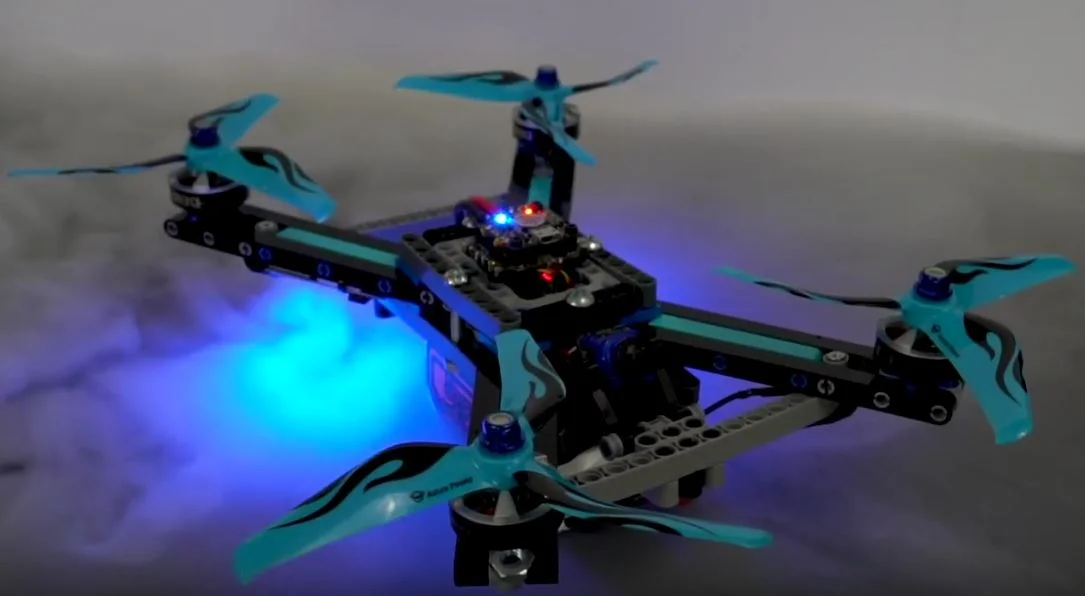
In the world of high-performance drones, speed is king. Professional racing drones, or FPV (First Person View) quads, are typically stripped-down carbon fiber frames holding screaming brushless motors that can push a craft past 100 mph. They are brittle, dangerous, and built for one thing: speed.
But a subculture of builders is proving you don’t need aerospace composites to break the sound barrier (relatively speaking). Using the yellow beams, black pins, and gearboxes of LEGO Technic, these engineers are constructing fully functional racing drones that hit 80 miles per hour.
Welcome to the world of “BrickWing,” a niche where childhood nostalgia meets 21st-century thrust-to-weight ratios.
The Paradox of Plastic
The first question any expert asks is: Why? LEGO is heavy. It is flexible. It has gaps that ruin aerodynamics. For a drone, which needs stiffness to prevent “motor wash” (vibrations that confuse the flight controller), LEGO seems like the worst possible material.
But as YouTuber and amateur aerodynamicist James “BrickRacer” Dalton discovered, LEGO Technic has a secret weapon: rigid cross-bracing.
“People think LEGO bends. It doesn’t—until it snaps,” Dalton explains. “By using 5×7 frames and 9L liftarms in a triangulated truss, I built a frame with a torsional rigidity of 87 Nm/degree. That’s stiffer than a cheap carbon fiber frame.”
The secret lies in the geometry. While standard LEGO bricks are hollow, Technic beams are solid ABS plastic with cross-shaped reinforcement holes. By stacking beams perpendicularly and locking them with 3L pins, builders create a quasi-monocoque chassis.
The Build: No Glue, No Screws
Building an 80MPH drone from LEGO is a brutal exercise in weight management. A standard 5-inch racing drone weighs about 250 grams (without battery). A solid LEGO frame? Often 400 grams. To hit 80 mph, builders must compensate with raw power.
The standard “BrickWing 80” specs include:
Motors: 4x T-Motor F60 Pro IV (2750KV) – capable of 1.8kg of thrust each.
Propellers: 5.1-inch tri-blade (the only non-LEGO part, as LEGO propellers shatter at 15,000 RPM).
Flight Controller: SpeedyBee F7 V3 (mounted via a custom 3D-printed shim, as LEGO studs don’t match standard 30.5mm mounting holes).
Battery: 6S 1300mAh LiPo (pushing 25.2 volts).
The build process is as much about suspension as it is about speed. Ingenious builders use LEGO’s friction pins to absorb vibration. A rubber band wrapped around the flight controller stack acts as a “dampener,” preventing the gyroscope from seeing the frame’s high-frequency chatter.
The Run: Sensory Overload
Piloting a LEGO Technic drone at 80 mph is terrifying. Unlike carbon fiber, which buzzes, ABS plastic screams. In onboard footage (captured via a naked GoPro rubber-banded to the top), the airframe visibly flexes by 3-5mm during a hard “punch out.”
On a recent test run in an abandoned warehouse, a pilot known only as LegoRacer_604 achieved 82.4 mph on a 200-meter straight. The sound wasn’t a hum; it was a high-pitched howl mixed with the rhythmic clicking of universal joints.
“At 70% throttle, you hear the gears,” LegoRacer_604 noted. “At 100%, you don’t hear the gears. You just pray.”
The Inevitable Crash
There is a dark side to plastic speed. At 80 mph, a carbon fiber drone shatters into expensive splinters. A LEGO Technic drone? It performs what the community calls a “rapid unscheduled disassembly.”
Because LEGO uses clutch power (the friction between studs and tubes), a high-speed impact is spectacular. The drone doesn’t bounce; it detonates into its constituent parts. Pins fly. Beams cartwheel. The battery usually ejects, trailing smoke.
But here is the magic of LEGO. When a carbon fiber drone crashes, you buy a new frame. When a LEGO drone crashes, you spend 20 minutes on your hands and knees, find the 40 scattered pieces, and snap them back together.
The Verdict: Is it a Toy or a Tool?
The 80MPH LEGO Technic drone exists in a grey area. It is too fast to be a toy (it can easily break bones) and too flexible to be a professional racing tool (the latency from frame twist ruins micro-cornering).
But as a feat of engineering, it is undeniable. It proves that the pin-and-beam system developed in 1977 is still capable of aerospace-level stress. It proves that a 10-year-old with a bucket of bricks and a soldering iron can technically build an aircraft.
As one builder posted on a forum after losing his drone to a river: “I don’t know where it landed. But I know that somewhere, a fish is flying at 80 mph.”
Safety Note
Do not attempt this with standard LEGO sets. This requires reinforced Technic beams, metal bearings, and professional FPV experience. A 6S battery can cause lithium fires; 80 mph plastic can cause lacerations. Always wear safety goggles and fly away from people.