


The skies over Ukraine and Russia have become a relentless theater of innovation and attrition, with uncrewed aerial vehicles (UAVs) redefining modern warfare. Since the full-scale invasion in 2022, Ukrainian forces have increasingly turned to long-range drone operations, not merely for reconnaissance but for direct, impactful strikes deep within Russian territory. These audacious missions, particularly the ukraine drone attack russian bombers, represent a significant shift in strategic thinking, targeting some of Russia’s most valuable military assets and forcing a re-evaluation of airspace security. As we move through 2025, understanding the evolution, impact, and future implications of these strikes is crucial to grasping the ongoing conflict.
Key Takeaways
- Strategic Shift: Ukraine’s drone attacks against Russian bombers have evolved from sporadic incidents into a consistent strategic campaign, aiming to degrade Russia’s long-range aviation capabilities and exert psychological pressure.
- Technological Advancement: Ukrainian ingenuity has led to the development and deployment of long-range, affordable drones capable of striking targets hundreds, sometimes over a thousand, kilometers inside Russia.
- Impact on Russian Airpower: These attacks have damaged or destroyed multiple Russian strategic bombers (e.g., Tu-22M3, Tu-95MS), disrupted operational tempo, and forced Russia to relocate assets, stretching their air defense systems.
- Information Warfare & Morale: Each successful drone strike serves as a powerful message, bolstering Ukrainian morale and demonstrating vulnerability within Russia’s seemingly secure borders, while forcing Russia to acknowledge gaps in its air defense.
- Future of Asymmetric Warfare: The continued success of Ukraine’s drone campaign showcases the effectiveness of asymmetric warfare, where a technologically outmatched defender can inflict significant damage on a larger aggressor through innovation and tactical surprise.
The Genesis of Ukraine’s Long-Range Drone Strategy
The early stages of the full-scale conflict saw Ukraine primarily defending its airspace against a numerically superior Russian air force. However, as the war progressed, a clear strategy emerged: take the fight beyond the front lines and target critical Russian military infrastructure. The decision to execute a ukraine drone attack russian bombers at their home airfields was a bold move, intended to reduce Russia’s capacity to launch devastating missile strikes on Ukrainian cities.
Initially, these operations were met with skepticism, given the vast distances and formidable Russian air defense networks. Yet, Ukrainian engineers and military strategists rapidly innovated, developing and modifying drones with extended ranges, improved navigation systems, and greater payload capacities. These were not off-the-shelf commercial drones, but bespoke solutions designed for long-distance penetration and precision strikes.
Early Milestones and Targets
The first notable long-range drone strikes occurred in late 2022, targeting airbases such as Engels and Dyagilevo, which house Russia’s strategic bomber fleet. These initial attacks, while perhaps limited in direct destructive power, sent a clear message: no part of Russia was entirely safe from Ukrainian retaliation. The psychological impact was immense, forcing Russian military command to reassess its domestic air defense posture.
Over time, the frequency and sophistication of these attacks increased. By 2023, Ukraine was demonstrating an ability to consistently reach deep inside Russia, striking targets vital to Moscow’s war effort. These targets included:
- Strategic Bomber Airfields: Engels, Dyagilevo, Shaikovka, Soltsy.
- Fuel Depots: Critical for sustaining military operations.
- Ammunition Depots: Disrupting the supply chain for Russian forces.
- Command and Control Centers: Aiming to degrade Russia’s operational coordination.
The focus on strategic bomber airfields was particularly significant. Russia’s Tu-95MS and Tu-22M3 bombers are key platforms for launching long-range cruise missiles, which have inflicted immense damage on Ukrainian civilian infrastructure and energy networks. By attacking these assets at their bases, Ukraine aimed to directly mitigate Russia’s ability to conduct such strikes.
The Evolving Capabilities Behind the Ukraine Drone Attack Russian Bombers
The success of the ukraine drone attack russian bombers campaigns hinges on continuous innovation in drone technology and operational tactics. Ukraine has not relied on a single drone model but rather a diverse array of UAVs, each tailored for specific missions. These range from relatively simple, explosive-laden “kamikaze” drones to more complex, multi-sensor platforms.
Key Drone Types and Their Evolution
Ukrainian drone development has been characterized by speed and adaptability. Instead of pursuing highly complex, expensive systems, they have often opted for simpler, more robust designs that can be mass-produced and quickly deployed. This approach has allowed them to rapidly scale up their drone production and overcome attrition.
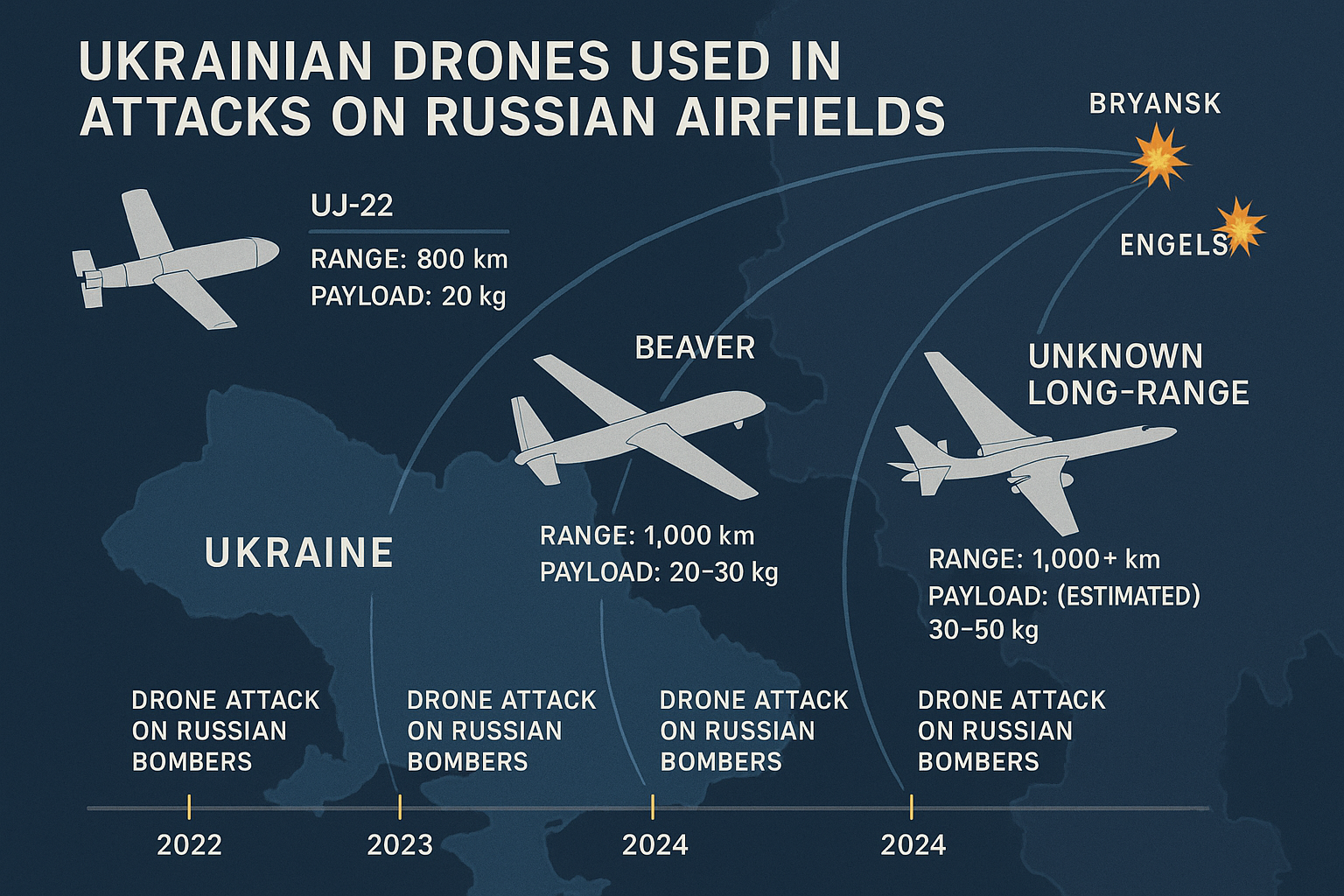
- UJ-22 Airborne: An early, propeller-driven UAV with a reported range of up to 800 km and a payload capacity for explosives. While somewhat slow, its simplicity made it an accessible option.
- Beaver (Bober) Drone: A more advanced, jet-powered or propeller-driven long-range drone, often described as having a distinctive “duck-like” canard design. It boasts an extended range (over 1000 km) and has been used in numerous deep strikes.
- Mugin-5 Pro: While originally a commercial drone, Ukrainian engineers have heavily modified these platforms for military use, increasing their range, hardening them against jamming, and equipping them with explosive payloads.
- Indigenous Designs: Ukraine has also developed several classified long-range drones, some reportedly reaching ranges exceeding 1,500 km, showcasing indigenous design and manufacturing capabilities.
These drones often incorporate advanced navigation systems, including satellite guidance (GPS/GLONASS) alongside inertial navigation systems (INS) to maintain course even when GPS signals are jammed. Stealth features, such as low radar cross-sections and flight profiles designed to evade radar detection, are also being increasingly integrated. For those interested in drone technology, understanding the diverse applications of UAVs, from military to recreational, highlights how critical advancements are made across different sectors. Learn more about the best drones for various uses.
Strategic Targets and Damage Assessments
The primary goal of these attacks is not always total destruction but often includes damaging aircraft, disrupting operations, and forcing the relocation of valuable assets. By 2025, several high-profile Russian bombers have been confirmed damaged or destroyed as a direct result of these strikes:
| Aircraft Type | Location Targeted | Impact Date (Estimated) | Reported Damage Status | Significance |
|---|---|---|---|---|
| Tu-22M3 Bomber | Soltsy Air Base | August 2023 | Destroyed | Key long-range missile carrier |
| Tu-22M3 Bomber | Dyagilevo Air Base | December 2022 | Damaged | Part of Russia’s strategic aviation fleet |
| Tu-95MS Bomber | Engels Air Base | December 2022 | Damaged | Primary platform for launching cruise missiles |
| Su-34 Fighter-Bomber | Morozovsk Air Base | April 2024 | Multiple damaged | Crucial for tactical bombing missions |
This table provides an overview of reported incidents and is based on open-source intelligence and official statements.
The damaged Tu-22M3s and Tu-95MS bombers are particularly significant. These aircraft are integral to Russia’s conventional and nuclear deterrence capabilities. Even damage requiring extensive repairs sidelines these assets, reducing Russia’s ability to project power and conduct long-range missile strikes.
The Strategic Impact of Ukraine Drone Attack Russian Bombers
The consistent targeting of Russian airfields and bombers has far-reaching strategic consequences that extend beyond mere material damage. These attacks represent a sophisticated approach to asymmetric warfare, designed to impose costs, disrupt operations, and influence enemy decision-making.
Degrading Russian Airpower
The most direct impact of the ukraine drone attack russian bombers is the degradation of Russian long-range aviation capabilities. Each damaged or destroyed bomber reduces Russia’s inventory of active aircraft and places additional strain on its maintenance and repair infrastructure. Furthermore, the need to disperse aircraft to less vulnerable airfields increases logistical challenges and response times for Russian operations. This forces Russia to expend resources protecting assets that would otherwise be used offensively.
Psychological Warfare and Morale
Every successful deep strike into Russia carries a potent psychological message. It demonstrates Ukraine’s resolve, ingenuity, and capacity to retaliate, even against targets deep within what Russia considers its secure homeland. This boosts Ukrainian morale, showing that their forces are capable of striking back effectively. Conversely, it erodes Russian morale, sowing doubt about the effectiveness of their air defense systems and the safety of their strategic assets. The feeling of vulnerability, even for an individual soldier or pilot, can be a significant psychological burden.
Forcing Adaptation and Resource Allocation
The threat of Ukrainian drone attacks has compelled Russia to divert significant resources to bolster air defense systems around critical military installations, including airfields. This means:
- Relocation of Assets: Russia has been observed moving strategic bombers to airfields further east, increasing operational distances and reducing their effectiveness in the conflict against Ukraine.
- Deployment of Air Defense Systems: Valuable air defense assets, such as Pantsir-S1 and S-400 systems, have had to be deployed to protect airfields and other infrastructure, thereby thinning their presence on the front lines or around other vulnerable targets.
- Implementation of Passive Defenses: Reports indicate Russia has resorted to rudimentary passive defenses, such as placing tires on aircraft wings or building berms around planes, highlighting the urgency and desperation to protect high-value assets.
These adaptations consume resources and manpower that could otherwise be used offensively or to support other military objectives.
Russia’s Counter-Measures and the Ongoing Drone-Defense Race
The persistent threat of a ukraine drone attack russian bombers has forced Russia to rapidly adapt its defensive strategies. This has led to an ongoing, high-stakes drone-defense race, with both sides continually innovating.
Air Defense Systems and Electronic Warfare
Russia possesses a formidable array of air defense systems, including the S-400 Triumf, Pantsir-S1, and Tor-M2. These systems are designed to detect and intercept various aerial threats, including cruise missiles and aircraft. However, low-flying, slow, and small drones present a unique challenge. Their small radar cross-section and ability to fly at very low altitudes can make them difficult to detect by traditional radar systems designed for larger, faster targets.
Electronic warfare (EW) systems are also crucial. Russia has invested heavily in EW capabilities, aiming to jam drone navigation systems (GPS/GLONASS) and control links. Successful jamming can cause drones to lose their way, crash, or fail to reach their intended targets. However, Ukrainian drones are increasingly equipped with anti-jamming measures and advanced inertial navigation systems, allowing them to continue their mission even under EW attack.
Passive Defenses and Dispersal
Beyond active air defense, Russia has also resorted to passive measures:
- Physical Barriers: Satellite imagery has shown the placement of vehicle tires on top of Tu-95MS bombers at Engels Air Base. While seemingly crude, this might be an attempt to reduce thermal signatures or offer rudimentary protection against shrapnel from drone impacts.
- Protective Berms: Earthen berms and revetments have been constructed around some aircraft to provide blast protection.
- Dispersal: A key defensive strategy has been to disperse aircraft across a wider network of airfields, making it harder for Ukraine to target multiple assets at once. This, however, stretches logistics and reduces operational readiness.
The effectiveness of these measures is debatable, but they underscore the severity of the threat posed by Ukrainian drones. The ongoing struggle highlights the dynamic nature of drone warfare, where defense is constantly playing catch-up to offensive innovation. Understanding how to defend against various drone threats is becoming critical globally. Explore educational videos on drone regulations and safety.
The Future of Long-Range Drone Warfare in 2025 and Beyond
As we progress through 2025, the trajectory of long-range drone warfare, particularly as exemplified by the ukraine drone attack russian bombers, points towards several significant trends. This conflict is acting as a crucible for new doctrines and technologies that will shape future military engagements worldwide.
Increased Autonomy and AI Integration
Future drones will feature increasingly autonomous capabilities. This means less reliance on human operators for real-time control, particularly during long-distance missions where communication links can be intermittent or jammed. Artificial intelligence (AI) will play a crucial role in:
- Target Recognition: AI algorithms will enable drones to independently identify and classify targets, even in complex environments.
- Navigation and Evasion: AI can optimize flight paths to avoid detection, navigate difficult terrain, and react dynamically to threats.
- Swarm Tactics: Instead of single drones, future attacks might involve coordinated swarms of UAVs, overwhelming enemy defenses through sheer numbers and synchronized movements.
The development of “loitering munitions” – drones that can circle an area for extended periods and strike when a target is identified – is also expected to accelerate.
Miniaturization and Stealth Technologies
The trend towards miniaturization will continue, making drones smaller, harder to detect, and more difficult to intercept. Coupled with advanced stealth materials and designs, future long-range drones could become exceptionally elusive, posing an even greater challenge to existing air defense systems.
Proliferation and Accessibility
The relatively low cost and accessibility of drone technology, compared to traditional manned aircraft or cruise missiles, means that long-range strike capabilities could become more widespread globally. This raises significant questions about future conflicts, where non-state actors or smaller nations might leverage similar tactics. The global drone market is booming, and advancements in professional drones, like those used for aerial photography, often trickle down or inspire military innovation.
Ethical and Legal Considerations
The increasing autonomy of drones raises complex ethical and legal questions, particularly concerning decision-making in targeting. As AI takes on more responsibility, the debate around “killer robots” and accountability for actions taken by autonomous weapons systems will intensify. International frameworks and regulations will be urgently needed to address these evolving challenges.
Conclusion
The ukraine drone attack russian bombers represents a pivotal chapter in modern warfare, demonstrating how ingenuity, technological adaptation, and strategic resolve can enable a less powerful adversary to challenge a larger, better-equipped foe. These strikes have not only inflicted material damage on Russia’s strategic aviation but have also forced a profound re-evaluation of defense doctrines, resource allocation, and the psychological dimensions of conflict.
As we look towards the rest of 2025 and beyond, the lessons learned from this ongoing drone war will undoubtedly shape military strategies worldwide. The relentless innovation by Ukraine in developing long-range UAVs, coupled with Russia’s struggle to effectively counter them, underscores a new era of asymmetric warfare where the skies are increasingly dominated by uncrewed, intelligent systems. The future of global security will inevitably involve grappling with the capabilities and implications of these evolving technologies.
Actionable Next Steps
For military strategists, defense planners, and policymakers, it’s crucial to:
- Invest in Counter-Drone Technologies: Prioritize research and development into advanced counter-UAV (C-UAV) systems, including sophisticated radar, electronic warfare, and kinetic interceptors capable of dealing with diverse drone threats.
- Develop Adaptive Air Defense Doctrines: Modernize air defense strategies to account for the unique challenges posed by small, low-flying, and autonomous drones, integrating layered defenses and rapid response protocols.
- Foster Indigenous Drone Innovation: Encourage domestic development and production of advanced drone technologies, both for offensive and defensive purposes, to maintain a competitive edge.
- Engage in International Dialogue: Participate in discussions to establish ethical guidelines and international norms for the development and use of autonomous weapon systems.
- Study the Ukraine-Russia Conflict Continuously: The ongoing conflict offers invaluable real-world insights into the dynamics of modern warfare. Continuous analysis and adaptation are paramount.

